Cart
0
$0.00
Poor philosophical foundation leads to poor messaging. It doesn't matter how right you are if no one listens, and people don't listen if they don't understand. It allows the right to frame the issues, from the "Moral Majority" movement during the Reagan years, to the MAGA movement of today. The left acquiesced morality to the right decades ago, and the right has capitalized heavily on this mistake.
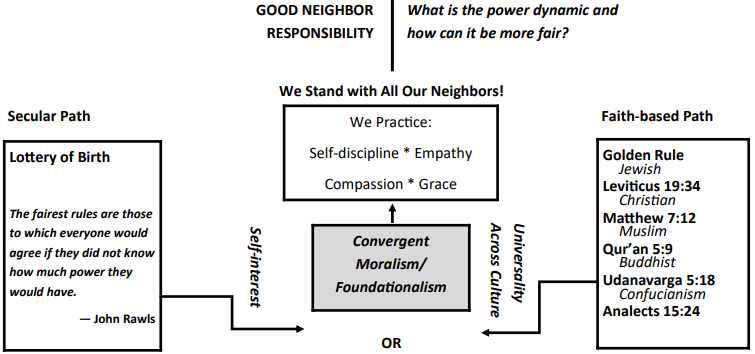
Now is the time to establish a clear philosophical foundation from which one can draw moral authority, requiring the convergence of secular and non-secular ideas. It does not matter which path one takes, secular or not; we end up with the same conclusion, allowing for the birth of a true coalition between believers of all faiths and non-believers alike.
At birth, not one of us knows in advance what our race, sex, gender, orientation, religion, neurodivergence or socioeconomic status will be. This is an undeniable fact. Birth is a lottery. In philosophical circles, this observation is called the "veil of ignorance", from which we can choose to derive our foundation. If not one individual, past, present or future, can know beforehand the life they'll have before them, it behooves us as "We the People" to craft legislation that seeks to make all births equal, or pragmatically, make all births as equal as possible.
Essentially, this is what John Rawls calls his theory of the original position. Rawls posits that when confronted with how to construct a social contract (i.e., our Constitution), most individuals would choose, out of self-interest, to even the playing field, to create a society that values each life and its potential equally. Rawls states, "The fairest rules are those to which everyone would agree if they did not know how much power they would have." Thus, a secular morality is borne.
All people are people. What better way to logically prove that than Rawls' original position? Regardless of qualifier, all people are born, and if people are born, should it not be equally? Should some people be valued more just because of who they were born to? An answer of anything but "no" to this question lead to various iterations of autocratic and authoritarian rule but never to a true democracy. By framing it in this way, it makes it difficult for reasonable people to disagree on principle; instead most disagreements would regard scope. Is our goal to eradicate homelessness or shore up the middle-class? Do we build society to primarily help the least of us, or shoot to maximize the mean or average position? Some amount of pragmatism will always be necessary, but if utilized properly, it could eventually end the debate on whether or not social programs should exist.
This logic also applies to purely economic situations. The capitalist cannot be blamed for being born capitalist, just as the worker cannot be blamed for being born a worker. Either or both of them should understand rationally that they did nothing to earn their position in life at birth. Each is an equal part of this experimental society, since each understands the chance of their birth. And if they don't, that's what our social contract is designed to address. In the eyes of the law, they are equal. The question then becomes, how do we try best to balance power imbalances? How do we offset the capitalist's wealth and power? Why with Unions, of course! But the answer is Unions because we have already agreed it is best to push for justice and equality from birth and it remains logically consistent all the way to the top.
Every major religion has some form of the Golden Rule. In Christianity, Jesus says, "Do to others what you would have them do to you." The Muslim tradition similarly states, "None of you [truly] believes until he loves for his brother that which he loves for himself." Hindus proclaim, "One should not behave toward others in a way which is disagreeable to oneself." The Jewish Talmud instructs, "That which is despicable to you, do not do to your fellow."
In fact, every major religion not only teaches some version of the Golden Rule, they emphasize that it is the most important part of their faith. The Golden Rule "sums up the Law and the Prophets", it "is the whole Torah, and the rest is commentary". From Islam: "O ye who believe! be steadfast in the cause of Allah, bearing witness in equity; and let not a people's enmity incite you to act otherwise than with justice. Be always just, that is nearer to righteousness." It is clear the idea of treating our neighbors justly is a common thread through religions that go back millennia in some cases. This is the one near-universal rule that all good-faith believers attempt to adhere to.
We also notice the absence of any sort of qualifier when each religious text refers to their "neighbors". None say, "love your neighbor, but only if they are straight," or "only love your neighbors that look, worship and pray like you." Each religion is clear: love ALL your neighbors, regardless of ANY qualifier. Jesus says in Matthew 7, "Enter through the narrow gate. For wide is the gate and broad is the road that leads to destruction, and many enter through it. But small is the gate and narrow the road that leads to life, and only a few find it. Watch out for false prophets. They come to you in sheep's clothing, but inwardly they are ferocious wolves. By their fruit you will recognize them… a good tree cannot bear bad fruit, and a bad tree cannot bear good fruit." Jesus implores us to take the DIFFICULT path of loving ALL of our neighbors, regardless of qualifiers. He warns us to watch for charlatans who seek to manipulate the Word for their own financial or political gain. Similar messages are foundational to all other major religious traditions.
Why do we choose to include the Golden Rule as a pillar of our coalition? Because the Golden Rule is a universally recognized precept that is designed to make us recognize the diverse humanity of our respective societies. It is usually held above all else in these traditions because of how important it is at providing the moral framework that allows for a just and productive society. This universality is central to our Good Neighbors' Roots. It shows us we are much closer and more connected to each other than the wolves Jesus mentioned would have you believe. Black, brown or white, we are all beautiful shades of wheat.